Exhibition Scale Models for Industrial, Aerospace and Defence Displays
Put the whole product on the table, even when the real machine or site cannot come to the exhibition. Start with the features visitors need to recognise, then choose the scale, level of detail and display arrangement.
Model-making references from 3D Printing Biz
These photographs from our manufacturing sub-brand show an industrial site display, its clear cover and a close view of the components. Use the visible layout and detail as a starting point for your own brief.
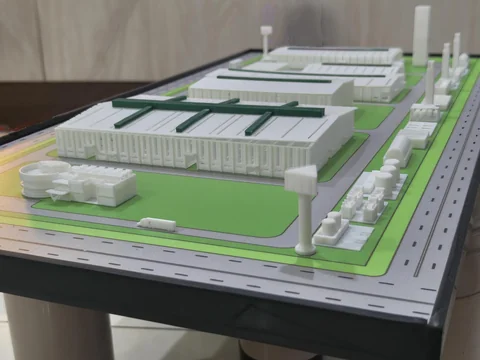
Overall layout
Industrial site model showing buildings, roads and landscaped areas.
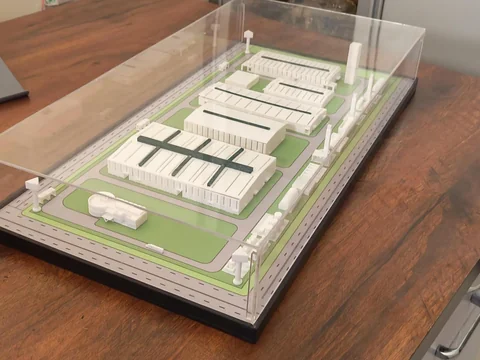
Display cover
Industrial site model on a table with a clear display cover.
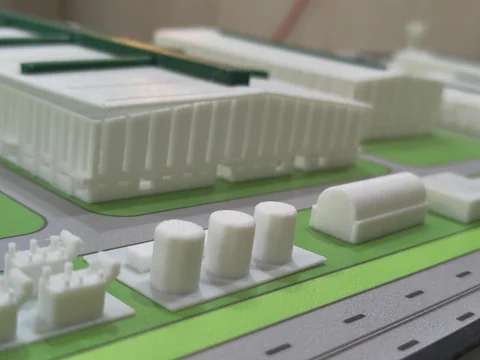
Component detail
Close view of an industrial site model showing tanks, buildings and roads.
Explore the 3D Printing Biz gallery or prepare your model brief. Confirm your own dimensions, material, finish and display requirements during the project review.
Design the exhibit around the conversation
A physical model gives a presenter a shared point of reference. Visitors can see an overall arrangement while the presenter identifies the components that matter to them. The useful starting question is therefore not only “what scale?” but “what should someone understand from this display in the first minute?”
For a product exterior, recognisable proportions and visible features may matter most. For a plant or system layout, the relationship between buildings, routes and equipment may be the main explanation. For a cutaway, the team must decide which internal information is cleared for display and how it will be presented. These choices guide the model envelope, detail hierarchy and supporting labels.
Resolve the physical details before production
| Part of the exhibit | What to decide | What to supply |
|---|---|---|
| Overall form | Scale or maximum display envelope, including base and cover | Dimensions, reference views and booth limits |
| Small features | Retain, simplify, exaggerate or omit | Marked features important to the explanation |
| Assembly | Fixed, removable or separately displayed pieces | Handling requirements and installation responsibility |
| Appearance | Visible faces, colour references and label content | Approved brand artwork and product references |
| Handover | Packed size, receiving location and setup sequence | Destination, access restrictions and installation date |
A display model represents the agreed subject; it is not automatically a functional prototype. Moving features, lights, removable parts and electrical equipment need their own review. If a feature is critical, name its expected behaviour and how it will be checked instead of relying on a broad description such as “working model”.
From review to handover
Begin with an approved reference set and identify missing information. Review the proposed dimensions, component breakdown and display arrangement before detailed work. Confirm appearance with the agreed references, then check the assembled exhibit against the accepted scope. Packing and receiving instructions complete the handover when included in the project.
Bring manufacturing and presentation requirements into the same discussion. A seam that is acceptable on a hidden face may distract on the main visitor side. A clear cover changes the available height and access for a presenter. A removable component needs both a reliable attachment and somewhere to put it during the explanation.
The photographs below show an existing industrial-site display from 3D Printing Biz. They provide visible examples of layout, cover and component detail. For your project, agree the actual scale, construction and finish through the model brief; the photograph alone does not establish those specifications.
Questions buyers ask
Can we start without complete CAD?
Drawings, dimensions and reference images can be reviewed first. Any design or reconstruction work is scoped separately.
Can a model include moving features?
We can review the desired movement. A static display and a working mechanism are different deliverables and must be quoted explicitly.
How is the model transported?
Packing and handling depend on size, fragility and destination. The quotation identifies the agreed arrangement.
Need printing-only manufacturing support?
For supplied scale-model files, printable subdivisions, process selection and finishing, visit 3D Printing Biz.